Full Funnel
Google Ads
+ eCommerce
Rebuild
For APF
- eCommerce & Google Ads:
Turning Around APF’s Declining eCommerce Sales With a Full-Funnel Google Ads + eCommerce Rebuild
Client: Australian Plastic Fabricators (APF)
Website: australianplasticfabricators.com.au
Channel: Google Ads (Search + Shopping/Performance Max), Google Merchant Centre, GA4, GTM, WooCommerce
Timeframe: 12 months
Headline results (Google Ads):
122K clicks
$252K conversion value
$1.15 average CPC
$140K ad spend
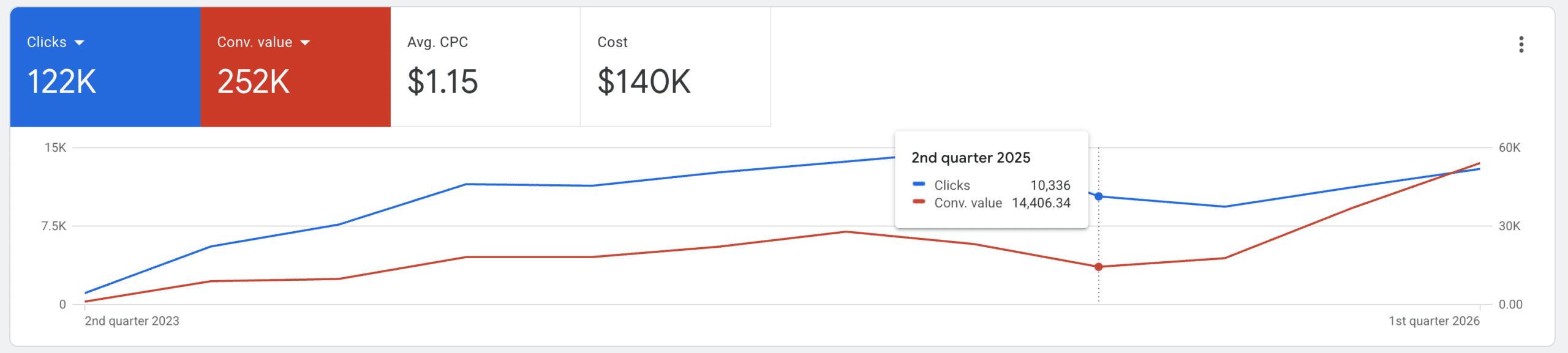
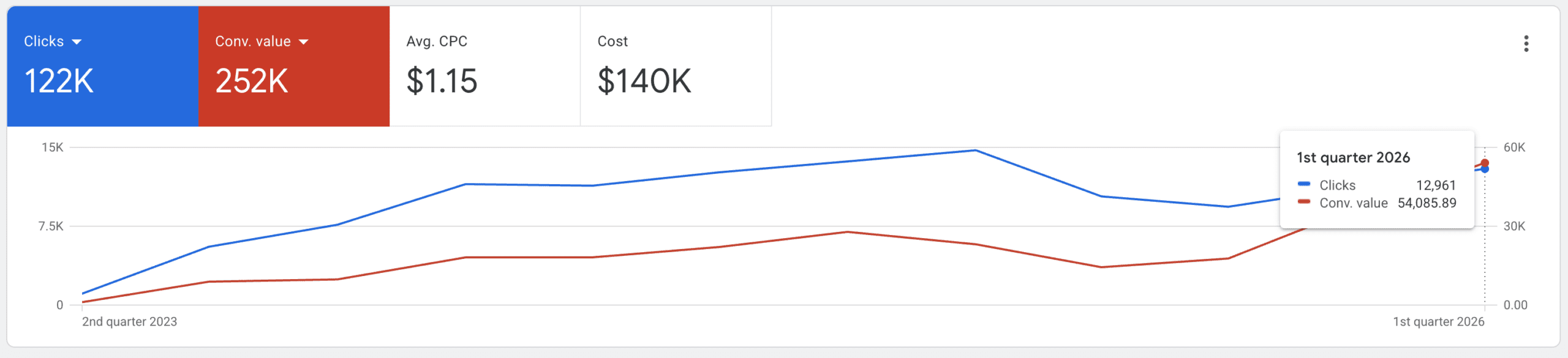
And a major lift in conversion value by the end of the period (e.g. Q1 2026 conversion value ~$54,086 from ~12,961 clicks, compared with much lower value periods earlier in the timeline)


The Situation: Strong Products, Weak Ecommerce Performance
Australian Plastic Fabricators is the type of business Australia needs more of: practical, specialist manufacturing capability, a real product range, and customers who rely on them for fit-for-purpose solutions.
But when we first spoke with the owner, Hemanshu Duggal, their online sales were under pressure. eCommerce performance was trending the wrong way and they were frustrated with their existing agency relationship.
This is a common scenario for established businesses that “should” perform well online but don’t. Not because the products are wrong — but because the ecommerce ecosystem (site mechanics, shipping rules, product data, tracking accuracy, Google Merchant Centre and campaign structure) isn’t built to support scale.
And here’s the truth most agencies don’t want to say out loud:
You can’t “ad copy” your way out of a broken ecommerce engine.
APF needed a partner who could diagnose the real constraints, fix them properly, and then use Google Ads in a way that matched the business model — not just the platform’s default settings.


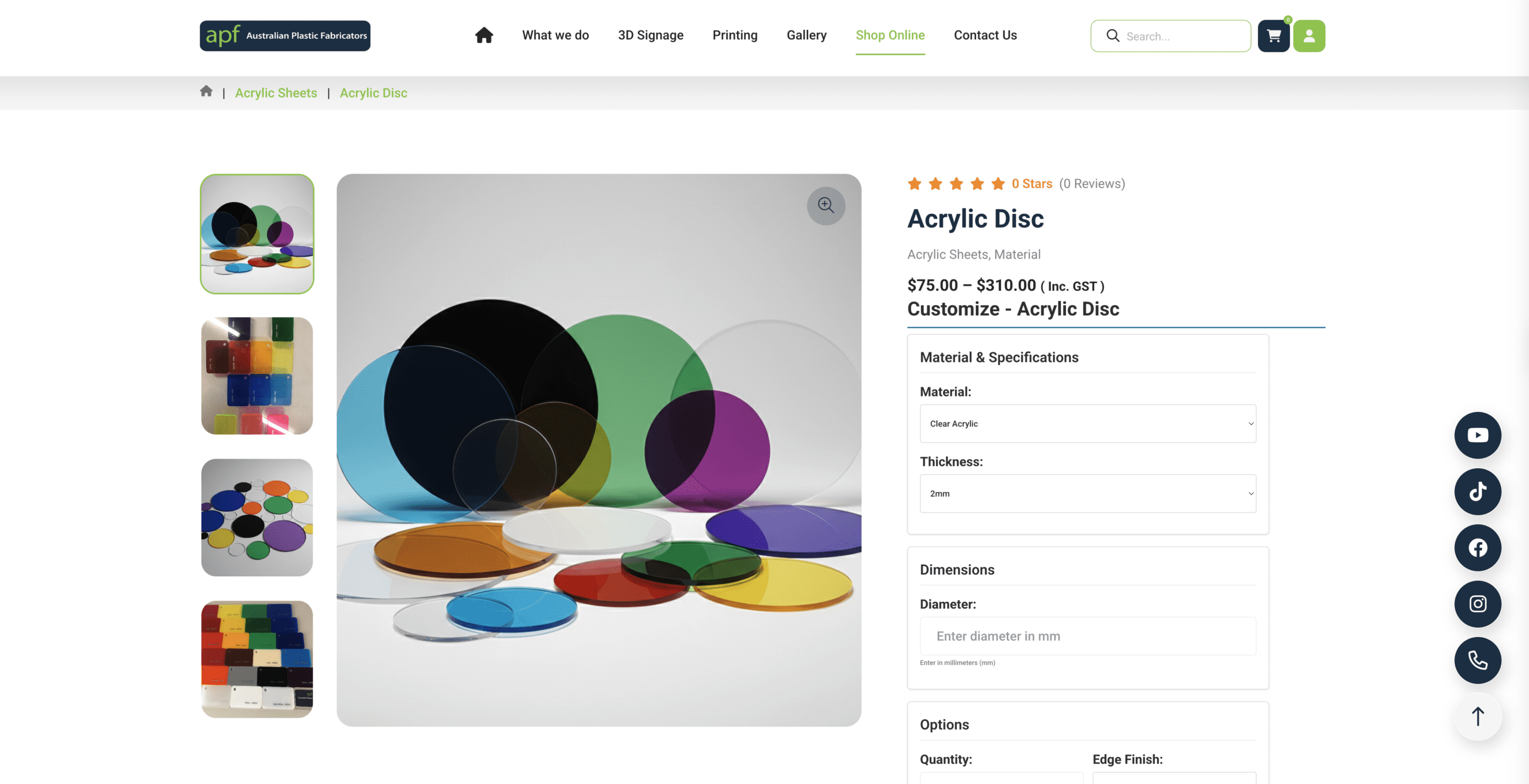
Why They Chose Remap Online: Search Experience That Goes Beyond the Ads Interface
During early conversations, APF learned about my background in search and digital platforms.
Before Remap Online, I was Head of Development for Yahoo in ANZ, and at the time Yahoo’s search results were powered by Google. That partnership exposed me to the technical and commercial mechanics of search at scale — not just running campaigns, but understanding how search ecosystems behave when you’re responsible for real revenue outcomes.
Google has only partnered with one other company globally on search in the way they did with Yahoo — the standout example being Yahoo Japan. That kind of proximity teaches you a lot about how Google thinks: where performance is won, where it’s lost, and how the data flows that feed the algorithm really work.
For APF, the key value wasn’t a story about “credentials”. It was confidence that we’d approach the problem like an engineer and a strategist — not like someone who’s only ever lived inside Google Ads Manager.
Our Approach: Fix the Foundations First, Then Scale Performance
From day one, we treated the project like a full eCommerce recovery plan.
Yes, we were hired to manage Google Ads. But we knew that ad performance would only be as strong as the systems feeding it:
- Shipping logic impacts conversion rate (massively)
- Product catalogue structure impacts Shopping performance
- Feed quality impacts how Google matches products to intent
- Tracking accuracy impacts Google’s bidding decisions
- GA4 + GTM configuration impacts what the business believes is “working”
- And all of this shapes how efficiently we can turn ad spend into revenue
So we broke the work into clear phases:
- Fix purchase friction (starting with shipping)
- Clean and restructure product data
- Rebuild Merchant Centre + feed connection
- Implement tracking properly (GTM + GA4 + ecommerce events)
- Rebuild campaigns and scale based on accurate data
Phase 1: Shipping Rebuild — Removing the #1 Conversion Killer
When we audited APF’s WooCommerce store, shipping was one of the first red flags.
Shipping is one of those ecommerce components that customers don’t praise when it works — but they absolutely punish when it doesn’t. If shipping feels unfair, confusing, or unpredictable, people abandon carts. And when people abandon carts, Google Ads can’t fix it. You just pay for traffic that never converts.
So we rebuilt APF’s shipping logic to match how customers actually buy from them.
What we changed
We restructured their entire shipping system so APF could:
- Offer free shipping to customers in locations close enough and purchasing products small/light enough to ship economically.
- For customers further away, or purchasing larger products, the cart would calculate the situation and clearly display: “Contact us for shipping” (instead of forcing a wrong or inflated shipping price that kills the sale).
This was not a small tweak. It required careful rule mapping inside WooCommerce, testing against product types, weights/dimensions (where available), and location logic.
Why this mattered
This single change improved the entire funnel:
- More customers progressed from product view → add to cart → checkout
- Checkout abandonment reduced because shipping outcomes felt fair and logical
- Conversion tracking became more meaningful because conversions weren’t being artificially suppressed by cart friction
- Paid traffic finally had a realistic chance of converting
This is the bit many businesses miss:
Ads don’t convert. The site converts. Ads just supply intent.
Here’s the revenue from when we started working with them, to the current date at the time of publishing;
Phase 2: Catalogue Restructure + Product Data Cleanup (Built for Search and AI Commerce)
Once shipping was stabilised, we moved to the next performance lever: the product catalogue.
APF had a broad range. But like many WooCommerce stores that grow over time, product organisation and data quality can become inconsistent:
- Variations not structured cleanly
- Titles not aligned to real search intent
- Descriptions missing key attributes people search for
- Inconsistent categories and tags
- Images not optimised for Shopping placements
- Attributes not standardised (size, material, use case, compatibility, etc.)
What we did
We restructured and cleaned their product data so that it was:
- Easier for customers to navigate
- Easier for Google to understand
- Easier to scale into Shopping, Performance Max and whatever comes next
Why this matters even more now
We’re moving into an era where ecommerce performance is increasingly shaped by machine interpretation:
- Google’s Shopping algorithm relies on clean product attributes
- AI-driven discovery surfaces products based on structured signals
- Feed quality becomes a competitive advantage, not an admin task
In other words:
If your product data is messy, you won’t just lose efficiency — you’ll lose visibility.
Phase 3: Google Merchant Centre Rebuild + API Feed Connection
With the catalogue cleaned up, we rebuilt APF’s Google Merchant Centre setup.
Merchant Centre is the engine room for Shopping ads. And when it’s misconfigured, you see predictable symptoms:
- Products disapproved or limited
- Incorrect pricing or availability shown in ads
- Missing attributes leading to poor matching
- Reduced impression share and weak Shopping performance
- Constant “patch fixes” instead of stable scale
What we did
We redeveloped the Merchant Centre account and built the API connection between WooCommerce and Google Merchant Centre. That ensured product information such as:
- Price
- Availability
- Titles and descriptions
- Images
- Key attributes
…were synced reliably and kept fresh.
Why the API connection mattered
For ecommerce, “set and forget” feeds are dangerous. Businesses change pricing, stock, product range, shipping thresholds — and if the feed lags behind reality, performance drops and customer trust takes a hit.
The API connection helped ensure Google was always working with accurate product truth.
Phase 4: GTM + GA4 Rebuild (A Single Source of Truth)
Next, we addressed what is probably the most underrated performance lever in Google Ads: measurement integrity.
If tracking is off, everything that follows is off:
- Google optimises bidding to the wrong signals
- Campaign performance appears better or worse than reality
- The business makes decisions based on bad numbers
- Budget allocation becomes guesswork
So we rebuilt the site-wide integration for Google Tag Manager (GTM) and reset ecommerce features inside GA4 so the client had a reliable reporting foundation.
What APF got out of this
APF ended up with a single point of truth and a live dashboard view that GA4 can do extremely well — if it’s configured properly.
This step also reduced confusion and helped move conversations away from opinions and towards evidence:
- What products are actually driving revenue?
- Where is checkout drop-off happening?
- What’s the real ROAS by campaign type?
- How do returning customers behave differently?
Once the measurement layer is trustworthy, performance improvements become much easier to identify and scale.
Phase 5: Ecommerce Events + Dynamic Value Tracking (Feeding Google What It Needs)
After GA4 and GTM were stable, we moved into a more performance-critical layer: conversion event design.
Most Google Ads accounts track only the final purchase. That’s better than nothing — but it limits how intelligently Google can learn, especially if purchase volume isn’t huge every day.
So we implemented key ecommerce events such as:
- Purchase
- Add to cart
- Begin checkout
And importantly, we included dynamic pricing/value, so conversion value was accurate — not guessed, not averaged, not hard-coded.
Why this matters
This did two things immediately:
- It improved Google’s ability to learn which traffic is high-quality (because it could see meaningful action before purchase)
- It gave us clearer insights into where the funnel was leaking
This is the difference between “running ads” and “running a performance system”.
Phase 6: Campaign Rebuild — Now the Fun Part
Only after the foundations were in place did we go hard in Google Ads.
Because now we had:
- Clean product data
- Stable shipping logic
- Accurate conversion tracking
- Merchant Centre syncing properly
- Real event signals for optimisation
- A clear view of what was happening across the funnel
This is where we refined:
- Campaign structure (balancing brand, non-brand, category intent, and Shopping coverage)
- Ad copy aligned to buying intent and differentiators
- Product imagery and titles tuned for Shopping placements
- Negative keyword management and query refinement (where relevant)
- Budget allocation based on proven conversion value, not gut feel
The philosophy behind the ads work
The biggest mistake we see is businesses (or agencies) diving into Google Ads Manager and thinking the fix is:
- “Change some headlines”
- “Switch bidding strategies”
- “Tweak audience signals”
- “Increase budget and hope”
That’s not strategy — it’s button pushing.
Google Ads rewards businesses that treat performance like an ecosystem: site mechanics + data + feeds + tracking + creative + campaign logic. If one part is weak, it drags everything down.
APF didn’t need a platform operator. They needed someone who could own outcomes end-to-end.
The Results: Efficient Traffic + Strong Conversion Value Growth
Across the 12-month period, APF achieved:
- 122K clicks
- $252K conversion value
- $1.15 average CPC
- $140K total spend
Even more telling was how performance matured. Early periods showed comparatively lower conversion value (for example, Q2 2025 conversion value around $14,406 from 10,336 clicks), while later periods lifted sharply (for example, Q1 2026 conversion value around $54,086 from 12,961 clicks).
That pattern is important because it shows what we were building: not a short-term spike, but an engine that gets smarter and more efficient as the data and structure improve.
When your shipping works, your feed is clean, your tracking is accurate, and your campaigns are structured properly, performance doesn’t just “improve”. It compounds.
Why This Worked: One Partner, No Blame Game, No Fragmented Delivery
APF’s turnaround wasn’t driven by a single hack. It was driven by doing the unglamorous work properly:
- Fixing checkout friction
- Structuring shipping logic
- Cleaning product data
- Rebuilding Merchant Centre
- Setting up GA4/GTM correctly
- Implementing proper eCommerce event tracking
- Then scaling ads based on truth, not assumptions
And it was delivered through a single partner model.
Most small and medium businesses don’t have time to coordinate:
- a dev contractor
- a tracking specialist
- an eCommerce consultant
- and a Google Ads agency
They also don’t have time for the “inter-agency blame game” that usually follows when results dip.
APF needed one point of contact who could see the whole system and fix it end-to-end.
That’s what Remap Online delivered — and that’s why the money started flowing again.
What’s Next: Scaling With Better Segmentation and Smarter Product-Led Growth
- With the foundations now in place, the next growth phase typically includes:
- Expanding high-performing product categories with dedicated campaign segmentation
- Iterating product titles/attributes further for Shopping visibility
- Using GA4 insights to improve merchandising (bundles, cross-sells, top exit pages)
- Testing landing pages for key commercial terms
- Building remarketing sequences that match buying cycles (especially for higher-consideration items)
- Preparing the catalogue for the next wave of AI-led ecommerce discovery (where structured data becomes even more valuable)